By: Ismael Kasooha
TURKMENISTAN
President Yoweri Kaguta Museveni has called on landlocked developing countries to ensure that all non-tariff barriers are stopped if poor counties are to unlock their full development potential.
“As long as the market remains fragmented due to tariff and non-tariff barriers; insecurity; poor Infrastructure and connectivity: and lack of access to the sea by some of the countries, Africa’s potential cannot be fully exploited,” noted Museveni.
The President explained that Modern economies are built on the production of goods and services.
“The more services and goods you produce, especially industrial goods, agricultural products to mention but a few, the wealthier a nation becomes. But, when you produce goods and services, the question is who buys what you produce? That is why the issue of producers and consumers is at the centre of modern economies,” noted Museveni.
The president said that Africa’s huge market of now 1.5 billion people, presents an opportunity for triggering the development and socio-economic transformation of our countries.
“This is why Uganda welcomes the concrete actions in the five priority areas for action of the Awaza Programme: structural transformation, Science, Technology and Innovation; trade facilitation and regional integration: transit, transport and connectivity; enhancing adaptive capacity, strengthening re resilience, reducing vulnerability to climate change and disasters as means of implementation,” he noted.
This was contained in the President’s message delivered for him by the Prime Minister, Rt. Hon. Robinah Nabbanja at the Third United Nations Conference on Landlocked Developing countries taking place in the City of Awaza in Turkmenistan, middle East.
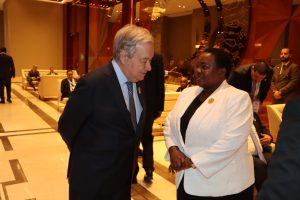
The Premier of Uganda Robinah Nabbanja talking to the United Nations General Secretary, Antonio Gutarez (left) after the meeting in Awaza City
Nabbanja led a delegation of Ugandans to deliberate on how 32 Landlocked Developing Countries in the world could unlock their full potential in order to obtain socio-economic transformation.
The Third United Nations Conference on Landlocked developing countries is taking place in the City of Awaza in Turkmenistan.
The Premier said that on climate change, Uganda was advancing climate resilience through green industrial policies and adaptive infrastructure. She called for the timely implementation of the New Collective quantified Goal (NCQG) decision adopted at COP 29 at Bako, Azerbaijan setting a goal with developed countries taking the lead, of at least 300 billion USD per year by 2035 for developing country parties for climate action.
“I wish to state that Landlocked Developing countries require revitalized global partnership. Uganda is committed to the implementation of the Awaza Programme of Action. Let this be the moment when “landlocked” no longer means ‘locked out,’ but instead signals our renewed determination to be linked in it, connected, competitive and committed to sustainable development,” explained Museveni.
Uganda, like other Landlocked countries, continues to face the challenge of lack of direct access to the sea hence negatively impacting her socio-economic transformation agenda.
“We believe that infrastructure development, both physical and soft, is fundamental in addressing this unique challenge faced by Landlocked Developing Countries (LLDCs). Uganda has set a bold target to increase the size of our economy by 2040 to 500 billion USD up from 50 billion USD in the financial year 2023/2024,” the statement read in part.
The President further called on developed countries to support landlocked developing countries with concessional loans to allow them finance their infrastructure development programmes.
The President of Turkmenistan, H.E. Serdar Berdimuhamedov called on landlocked developing nations to further strengthen their Cooperation through developing joint infrastructural projects, digital connectivity, and adapting climate resilience mechanisms as a priority.
During the opening ceremony, United Nations Secretary General Antonio Gutarez highlighted the challenges Landlocked countries face making it difficult for them to realise their development needs.
The Conference has attracted Heads of State, Vice Presidents and Prime Ministers and Ministers representing their respective countries.
End