By: Ismael Kasooha
KYANKWANZI
The Prime Minister of Uganda Robinah Nabbanja has commissioned 398 health center III’s spread across the country and three blood banks to improve on health service delivery.
In the financial year 2018/2019, cabinet decided to improve maternal and child indices to achieve sustainable Development Goals (SDGs) by constructing and upgrading the existing health center IIs to health center IIIs and establish others where they didn’t exist.

Prime Minister Robinah Nabbanja (centre) arriving for the Commissioning of the Health Centres
“I convey our highest and most profound gratitude to His Excellency the President of the Republic of Uganda, Gen. Yoweri Kaguta Museveni, whose visionary leadership and unwavering commitment to the health and well-being of the people of Uganda have made this achievement possible. His prioritization of healthcare as a pillar of National Development continues to guide and inspire all of us in government and beyond. These Health Centres stand as a testament to his enduring legacy of building a healthier, stronger Uganda,” noted Nabbanja.
The Premier said that these achievements today align with the commitments set forth in the NRM Manifesto, Uganda Vision 2040, and the National Development Plans III and IV.
“These facilities represent a transformative leap forward in our healthcare system—bringing quality, accessible care closer to our communities and ensuring that every Ugandan has the opportunity to lead a healthy, productive life.” she said.

The General Ward at Kikoma Health Center III in Kyankwanzi District. All the facilities have staff quarters to enable Health Workers serve the people
Nabbanja was flanked by the Minister for Health Dr. Jane Ruth Aceng and the Local Government Minister, Raphael Magyezi at a function that took place at Kikoma Health Center III in Kyankwanzi District.
Nabbanja challenged health workers to prioritize preventive health care by sensitizing the people through outreaches and at the facilities.
“Health workers, you are key in ensuring that we have a healthy population and I appeal to you to sensitize our people to preventive health care to reduce the disease burden the country faces,” said Nabbanja. She added that the commissioning of these health facilities was a big milestone in Uganda’s health sector.
“Fellow citizens, I speak with utmost confidence that the commissioning of these 398 Health Centre IIIs will significantly impact healthcare outcomes across our nation. They stand not just as buildings equipped with modern facilities, but as beacons of hope—ensuring that essential health services are within reach and that lives are continually safeguarded,” Nabbanja said.
The Minister of Health, Dr. Jane Ruth Aceng told the gathering that the Minister for Local Government Raphael Magyezi submitted 2,184 Sub counties, Town Councils and Divisions, (Administrative units) that did not have Health Center IIIs but now 1,696 which is 78% have functional Health Center IIIs and only left with 488 which is 22% to have this done.
However, Aceng expressed concern that the facilities that have been commissioned need to be connected to water and electricity for better service delivery.
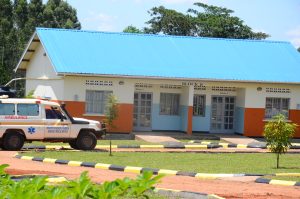
One of the staff quarters at Kikoma Health Center III in Kyankwanzi District
“The low utilization of the health facilities especially by mothers can be attributed to lack of water and electricity in the facilities. Therefore, I appeal to the Ministry of Water & Environment to work on this urgently to enable effective use of the facilities.
Dr. Aceng said that Uganda has had a remarkable achievement in maternal mortality rate reduction from 346 to 189 per 100,000 live births representing a 43% drop.
Dr. Charles Olaro, the Director General Health Services at the Ministry of Health expressed concern over the underutilization of the health facilities established by the government.
Olaro said that according to reports over 40% of the cases registered at the facility were malaria cases.
“35 deliveries since October is a very low number because a Health Center III is expected to handle a minimum of 70 deliveries per month. I appeal to the local community to make use of this facility,” said Olaro.
Rogers Ayiku, who represented the World Bank Country Manager said that Uganda is progressing well in health service delivery.
Ayiku said that the World Bank in partnership with the Ministry of Health, did an analysis, the Public expenditure review and findings revealed that Uganda is progressing better compared to the other regional nations.
According to the World Bank, these facilities will serve over 10m people who were underserved previously.
Raphael Magyezi, the Local Government Minister received the facilities and later handed them over to the local leaders and asked them to ensure they guard them jealously to serve the purpose.
Local leaders hailed the government for the health facilities constructed.
The Uganda Intergovernmental Fiscal Transfers Program (UGiFT) aims to improve the equity and adequacy of fiscal transfers and enhance Local Government management of resources for health and education. It is coordinated by the Ministry of Finance, Planning and Economic Development.
End