By: Ismael Kasooha
KAMPALA
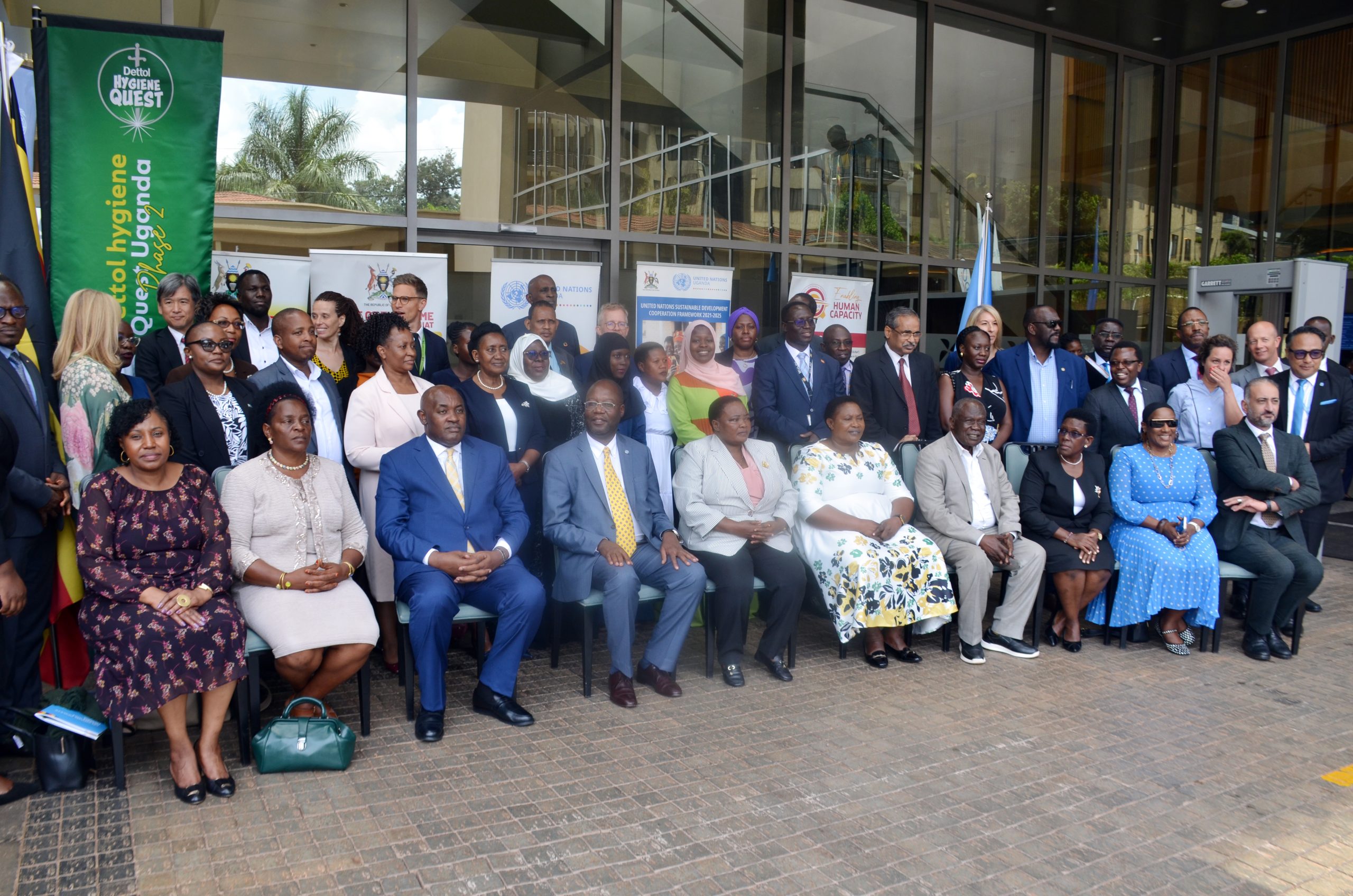
The Prime Minister Rt. Hon. Nabbanja Robinah has pledged the government’s continued collaboration with the United Nations agencies for the country to attain the Sustainable Development Goals by 2030 and Uganda’s Vision 2040.
Uganda, with a population of 45.9 million, is a landlocked country but over recent decades, the country has made notable progress in its development transformation journey.
The Prime Minister Rt. Hon. Nabbanja Robinah (left) being welcomed by Ministers and UN Resident Coordinator Leanrad Zulu (2nd right) for the Joint Steering Committee meeting in Kampala
The 2025 Human Development Report (HDR) indicates Uganda’s Human Development Index increased from 0.342 in 1990 to 0.582 in 2023.
Nabbanja said that Uganda was among the 7 fastest growing economies in the world due to sustained peace and security, macroeconomic stability, favourable weather conditions, investment in the oil sector; and progress in implementing the Parish Development Model (PDM).
Notwithstanding this progress, the 2024 United Nations Common Country Analysis (CCA) indicates Uganda still faces considerable gaps in achieving the Sustainable Development Goals (SDGs).
Nabbanja who is also the Kakumiro Woman Member of Parliament made the remarks on Wednesday while chairing a Joint Steering Committee Meeting between the Government of Uganda and United Nations with development partners to discuss the new Sustainable Development Cooperation Framework for 2026-2030 in Kampala.
The new UN Sustainable Development Cooperation Framework 2026 2030 is a central instrument guiding the United Nations engagement in Uganda. It comes after the successful implementation of the 2021 -2025 Development Cooperation Framework.
A section of participants including Permanent Secretaries attending the Joint Steering Committee meeting at Four Points Hotel Kololo
The 5th Joint Steering Committee (JSC) for the UN Cooperation Framework 2021–2025 is a high-level body that provides strategic guidance and oversight for the UN’s collaboration with a specific government to support national development priorities.
The committee that is co-chaired by the UN Resident Coordinator in Uganda Leonard Zulu reviews progress, aligns priorities, and strengthens accountability between the Government of Uganda and partners.
The new Sustainable Development Cooperation Framework for 2026-2030 is aligned with Uganda’s National Development Plan (NDP) IV that runs from 2025/2026-2029/2030 period.
Nabbanja briefed the Development Partners that Uganda was on the right trajectory to achieve the said goals due to good leadership of President Yoweri Museveni at the helm.
“We have introduced the parish Development Model (PDM) so that we leave no one behind in our socio-economic transformation agenda,” said Nabbanja.
She noted that Uganda’s sustained peace and stability had enabled Ugandans to flourish and contribute to the development of the country.
Commissioner Strategic Coordination, Edward Walugembe (extreme right) consulting with the Permanent Secretary OPM, Mr. Alex Kakooza (2nd right) during the Joint Steering Committee Meeting at Four Points Hotel Kampala. Also present was the Deputy Head of Public Service in Charge of Performance & Service Delivery, Ms. Jane Mwesige Kyarisiima (extreme left) and the Chairperson of the National Planning Authority, Prof. Pamela Mbabazi (2nd left)
However, the UN Resident Coordinator, Leonard Zulu reported that the development assistance through the United Nations continues to dwindle which calls for action.
Zulu also said the UN support towards this new Cooperation Framework was expected to provide support towards the Parish Development Model targeting the refugee sector.’
To support the implementation of NDP-IV, Vision-2040, and the 2030 and 2063 Agendas, UNDP collaborated with other United Nations organizations —under the leadership of the United Nations Resident Coordinator (UNRC)—to evaluate the current United Nations Sustainable Development Cooperation Framework (UNSDCF) and prepare the CCA.
These efforts informed the development of the UNSDCF for 2026–2030, which identifies three strategic priorities, namely Transformative and inclusive Human Development, Sustainable ecosystems and climate-smart development and Integrated, inclusive and rights-based governance for transformative development.
This country’s programme draws directly from the CCA and UNSDCF. UNDP will leverage its mandate, institutional capacity, and strategic position to contribute across all three priority areas.

A section of Ministers attending the Joint Steering Committee meeting at Four Points Hotel Kololo
In the new Framework, the Ministry of Gender, Labour and Social Development intends to focus on vulnerable communities including children with disabilities.
A cross section of Ministers, State Ministers, technical officers and partners participated in the meeting.
The Joint communique was presented by Dr. Chris Baryomunsi, the Minister for ICT and National Guidance.
Both the Ugandan Government, UN and Development Partners pledged continued collaboration for the socio-economic transformation of Uganda.
End


